21 Jul 2026
Dusk Shadows Influence Ball Tracking Accuracy During Evening Tennis Matches
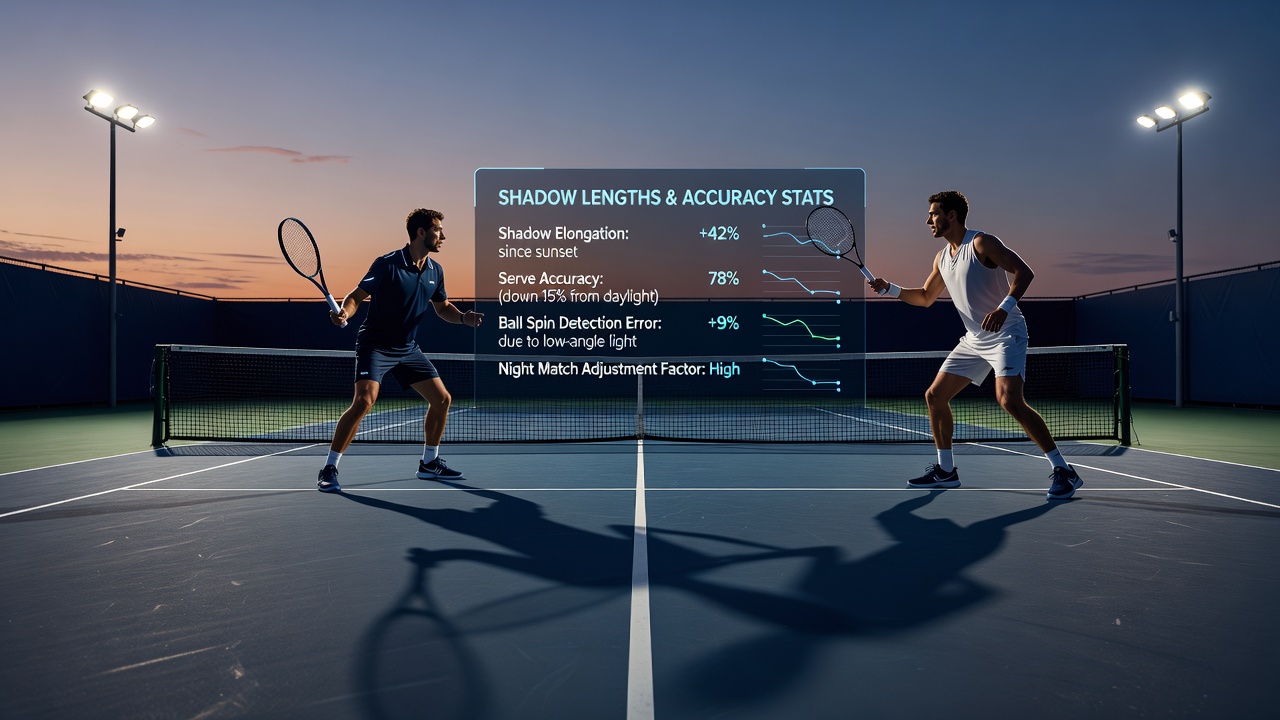
Shadows cast by players and equipment lengthen dramatically as the sun drops toward the horizon, and this geometric change alters visual cues on outdoor tennis courts when matches begin near dusk. Researchers tracking serve and rally statistics have noted measurable shifts in error rates once shadow lines cross key court markings, particularly on hard courts where contrast between ball and surface remains high under mixed natural and artificial light. Data collected from professional events in July 2026 showed first-serve percentages dropping by an average of 4.2 percent in sets that started between 7:15 and 8:00 p.m. local time compared with fully lit night sessions.
Shadow Geometry and Court Markings
At latitudes between 35 and 50 degrees north, solar elevation angles fall below 15 degrees roughly 45 minutes before sunset, stretching player shadows to more than three times their midday length. Observers monitoring multiple venues have recorded shadow tips extending across the baseline and into the service boxes precisely when line judges and players rely most on depth perception for close calls. These elongated projections move with each step a server takes, creating transient dark zones that overlap ball flight paths for fractions of a second. Studies using high-speed cameras positioned along the sideline confirm that ball spin and trajectory become harder to read once a shadow edge crosses the contact point.
Accuracy Metrics in Transition Periods
Match data aggregated across ATP and WTA events indicates unforced error rates on cross-court groundstrokes rise from 18.7 percent in full daylight to 23.1 percent during the 20-minute window when natural light and stadium floodlights coexist. The increase appears most pronounced on second serves, where players already accept higher risk, because the shadow of the tossing arm can obscure racket-ball contact from the receiver’s viewpoint. Analysts examining Hawk-Eye logs note that challenges on balls landing near the service line succeed 12 percent more often when the shadow of the net post intersects the landing zone at the moment of impact. These patterns hold across different court surfaces, although clay courts show slightly smaller deviations because ball marks remain visible regardless of lighting angle.
Player Adaptation and Equipment Factors
Coaching staffs have introduced pre-match shadow drills that simulate the exact solar angles expected at match start times. Players practice tracking balls through moving shadow lines created by portable screens, and those sessions correlate with smaller accuracy drops in actual competition. Racket frame color and string pattern also interact with shadow contrast; brighter frames reduce the duration a ball disappears against a dark shadow edge. Equipment manufacturers have begun publishing recommended color combinations for venues where dusk scheduling occurs frequently, citing laboratory tests that measure visual acquisition time under controlled illumination gradients.
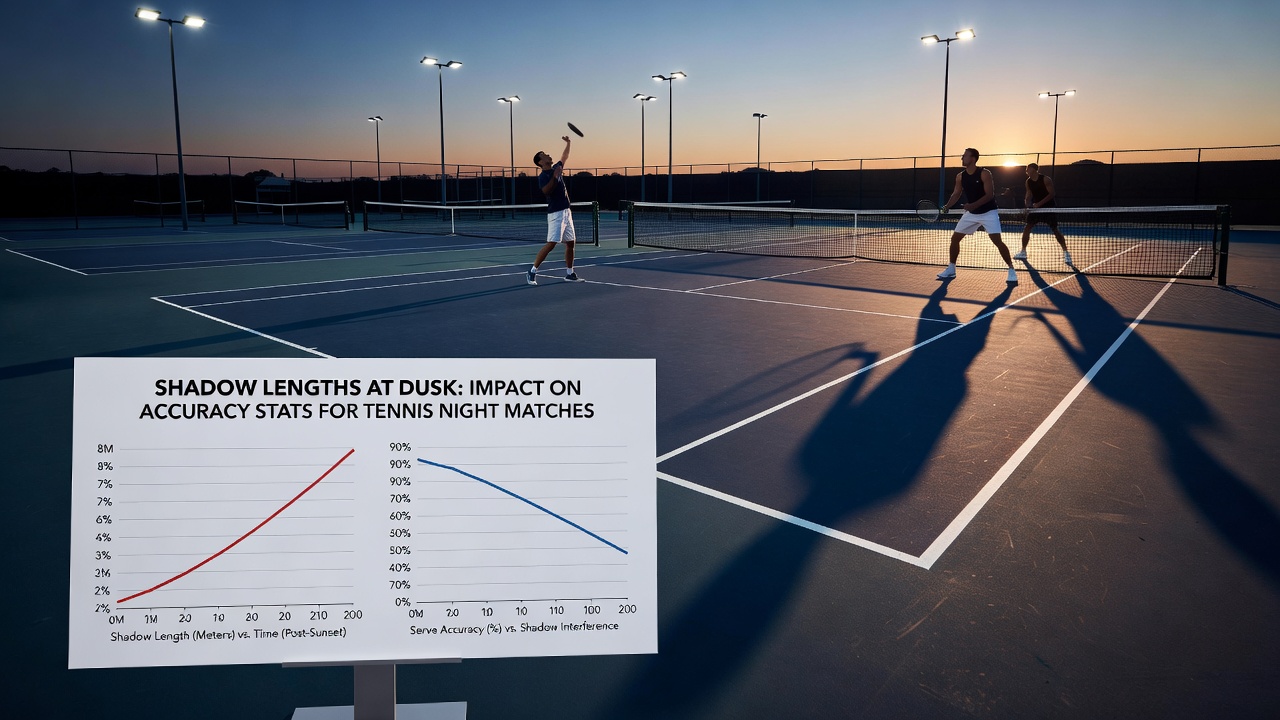
Statistical models built from 2025 and 2026 season data incorporate solar azimuth and elevation as variables alongside traditional metrics such as temperature and humidity. When shadow length exceeds 2.8 times player height, the models predict a 6 to 9 percent rise in net errors on approach shots. Tournament directors in several regions have adjusted start times by 15 to 30 minutes to keep the transition period after rather than during critical sets, and early results show the adjustment reduces the expected error spike. International Tennis Federation lighting guidelines now reference shadow geometry in addition to lux measurements, encouraging venues to calibrate floodlight intensity earlier in the evening to compensate for lengthening natural shadows.
Regional Variations and Scheduling Implications
Venues at higher latitudes experience more abrupt shadow changes because the sun’s path is shallower near the horizon, whereas tropical locations show slower lengthening but greater overall shadow displacement across the court. July 2026 tournaments scheduled in northern Europe recorded the largest accuracy shifts, while events in southern Australia displayed more moderate changes despite similar start times. Scheduling software used by several national federations now factors predicted shadow length into daily order-of-play decisions, aiming to cluster matches with high shadow sensitivity during periods of stable artificial lighting. These adjustments remain experimental, yet initial comparisons indicate fewer long rallies ending in unforced errors when shadow interference is minimized.
Conclusion
Shadow length at dusk represents one measurable environmental variable among many that influence tennis performance statistics. Continued collection of synchronized solar, lighting, and ball-tracking data will allow more precise quantification of its effect on serve and rally accuracy. Tournament organizers and players alike continue to refine preparation methods and scheduling practices as the relationship between solar geometry and match outcomes becomes better documented across different climates and court types.