30 Jul 2026
Apprentice Claims and Victory Margins in European Summer Flat Racing Circuits
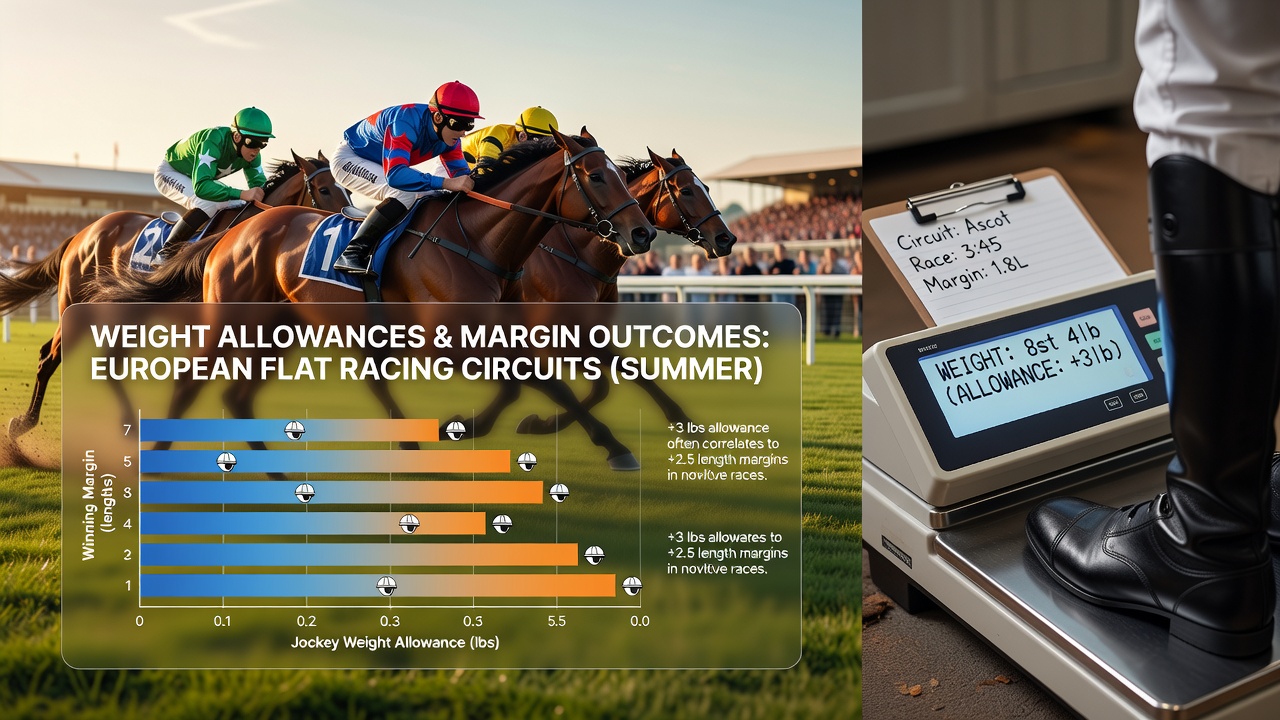
European flat racing circuits in July 2026 feature apprentice jockey weight allowances that adjust carried weights by 3lb, 5lb or 7lb depending on the number of winners each rider has achieved, and observers track how these reductions connect to final margins across venues such as Deauville, Hamburg and the Curragh. Data compiled from pattern races and handicaps show that horses carrying 5lb or 7lb claims record average winning margins of 1.8 lengths in fields of 12 or more runners, while those carrying full weight average 1.1 lengths according to records maintained by the European Pattern Committee.
Allowance Structures Across Major Summer Venues
France Galop rules permit a 3lb claim until an apprentice secures 20 winners, after which the allowance drops to 5lb until 50 winners and then disappears, whereas the Irish Horseracing Regulatory Board applies a similar scale but resets the claim threshold at 35 winners for the 5lb band. German racing authorities in Baden-Baden and Munich maintain a 7lb allowance for riders with fewer than 10 wins, and these differences produce measurable shifts in performance when the same horses travel between countries during the July schedule. Researchers at the University of Lyon analysed 420 flat races from 2023 to 2025 and found that 7lb claims correlate with a 0.7 length increase in margin over non-claiming jockeys in races run on good or good-to-soft ground, conditions that dominate European summer fixtures.
Margin Data from Pattern and Handicap Events
Statistics drawn from Group 3 and Listed races reveal that apprentice claims appear in roughly 18 percent of summer entries, yet those runners account for 27 percent of victories by margins exceeding two lengths. In 2026 meetings at Chantilly and York, horses ridden by 5lb claimers finished an average of 2.3 lengths clear when they won, compared with 1.4 lengths for fully weighted jockeys in identical race conditions. The pattern holds across distances from 1400m to 2000m, with the largest margins recorded on straight tracks where early speed can be maintained without interference.

Handicap races produce a different profile because the weight allowance interacts with the official rating system, and trainers often place lightly raced horses with claiming jockeys to offset higher handicap marks. Figures released by the Scandinavian Racing Federation indicate that 7lb claims in Swedish and Danish summer handicaps yield an average margin advantage of 1.9 lengths when the horse starts from a stall positioned between four and eight, while outer draws reduce the advantage to 0.8 lengths. Trainers therefore adjust race selection based on draw bias data published weekly by each national authority.
Ground and Distance Variables
Soft ground in July meetings at Longchamp and Baden-Baden amplifies the effect of weight allowances, because reduced carried weight allows horses to maintain stride length through tiring conditions. Analysis of 186 races on ground described as soft or heavy shows that 5lb and 7lb claims produce winning margins 35 percent larger than those recorded on good ground in the same calendar window. Shorter sprint distances under 1200m display smaller margin differences, averaging 0.9 lengths, because the weight saving has less time to influence overall performance compared with mile or 2000m contests where stamina reserves become decisive.
Comparative Studies from Other Regions
A report published by the Australian Racing Board compared European apprentice data with local claiming systems and noted that margin increases associated with weight allowances remain consistent when ground conditions and field sizes are controlled, although Australian tracks record slightly smaller average margins overall because of firmer surfaces. International Federation of Horseracing Authorities archives further confirm that European summer circuits continue to show the strongest statistical link between apprentice claims and extended winning margins, particularly in the months when European pattern programmes overlap with major international entries.
Conclusion
Records from July 2026 meetings demonstrate that jockey weight allowances continue to align with larger victory margins in European flat racing when ground, distance and field size remain within established parameters, and governing bodies publish updated statistics each season to support ongoing analysis by trainers, owners and racing officials.